Cartech - All About Auto

Showing posts with label rotation. Show all posts
Textual description of firstImageUrl

How Often Should I Rotate My Tires? A Complete Guide

Cartech image

Tire rotation is a routine maintenance task essential for prolonging the life of your tires and ensuring a safer, smoother ride. Many drivers overlook the importance of regular tire rotation, yet it’s one of the easiest ways to maximize the lifespan of your tires and enhance your car's overall performance. So, how often should you rotate your tires? Generally, tire rotation is recommended every 5,000 to 7,500 miles, though specific intervals may vary depending on factors like your driving habits, tire type, and manufacturer recommendations.

In this comprehensive guide, we’ll dive into everything you need to know about tire rotation: what it is, why it matters, the recommended frequency, and other tips to help you take better care of your tires.

What is Tire Rotation?

Tire rotation involves changing the position of each tire on your vehicle. In most cases, this means swapping front tires to the back and back tires to the front. The process may also involve switching tires diagonally, depending on your vehicle’s drive system (front-wheel drive, rear-wheel drive, or all-wheel drive). The primary purpose of tire rotation is to promote even wear across all tires, which is key to ensuring your tires last as long as possible.

Why Is Tire Rotation Important?

Rotating your tires is more than just moving them around for the sake of routine maintenance. It directly impacts several crucial aspects of your vehicle:

• Extended Tire Life: Tires wear differently depending on their position on the vehicle. Front tires, especially in front-wheel-drive vehicles, typically wear faster than rear tires due to additional forces from steering and braking. Regularly rotating tires helps balance the wear, making all four tires last longer.

• Better Traction and Handling: Unevenly worn tires can impact your car’s handling, reducing traction and increasing the chances of skidding, especially in adverse weather conditions. Properly rotated tires can provide a smoother, safer driving experience.

• Fuel Efficiency: Evenly worn tires provide consistent traction and require less energy to rotate. This improves fuel efficiency, potentially saving you money at the pump.

• Enhanced Safety: Worn tires can be dangerous, increasing your stopping distance and susceptibility to blowouts. Tire rotation ensures that all tires are wearing at an equal rate, helping maintain consistent traction and reducing the risk of accidents.

How Often Should I Rotate My Tires?

The general recommendation for tire rotation is every 5,000 to 7,500 miles, or approximately every six months for the average driver. However, this interval can vary depending on your vehicle’s type, tire type, and driving habits.

1. Consult Your Owner’s Manual: The best place to start is by consulting your vehicle’s owner’s manual. Most manufacturers include tire rotation recommendations specific to your make and model, which can provide a more tailored guideline for your car’s needs.

2. Tire Type Matters: High-performance tires, all-terrain tires, or off-road tires may have different wear characteristics than standard all-season tires. In some cases, these tires may require more frequent rotation, especially if you drive in demanding conditions or on rough terrain.

3. Driving Habits: If you frequently drive in stop-and-go traffic, carry heavy loads, or often navigate curvy roads, your tires may wear faster than average. Aggressive driving, including hard braking and quick acceleration, can also accelerate tire wear, necessitating more frequent rotation.

4. Vehicle Type: Vehicles with front-wheel drive (FWD) place more pressure on the front tires, while rear-wheel drive (RWD) vehicles place extra stress on the rear tires. As a result, FWD and RWD vehicles may benefit from rotations every 5,000 miles, while all-wheel drive (AWD) vehicles, which distribute power more evenly, might go longer between rotations.

Types of Tire Rotation Patterns

There are several rotation patterns to consider, each depending on your vehicle's drive type and tire type.

1. Forward Cross Pattern: Suitable for front-wheel drive vehicles, this pattern moves front tires to the rear and crosses them, so the right front tire goes to the left rear, and the left front tire goes to the right rear. Rear tires move directly to the front on the same side.

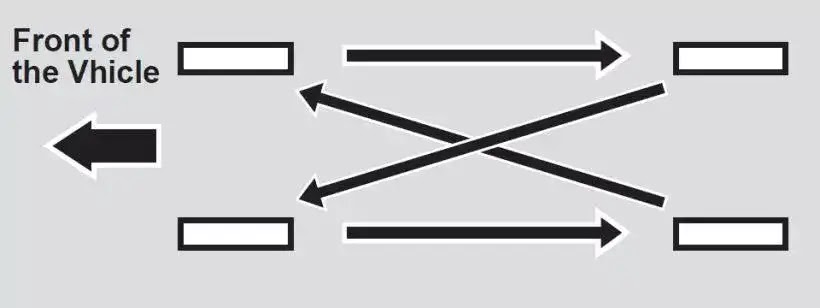
2. Rearward Cross Pattern: Best for rear-wheel drive and four-wheel drive vehicles, this pattern moves rear tires to the front on opposite sides, while front tires move directly to the rear.

3. X-Pattern: Used for front-wheel drive vehicles, all four tires are rotated diagonally. The front right tire moves to the rear left, the front left moves to the rear right, and vice versa.

4. Side-to-Side Pattern: For vehicles with non-directional tires of different sizes between the front and rear axles, this pattern swaps tires on the same axle side-to-side.

5. Front-to-Back Pattern: This pattern simply switches front tires to the back on the same side and vice versa.

Signs That You Need a Tire Rotation

If you’re unsure when your tires were last rotated, there are a few signs that could indicate it’s time for a rotation:

• Uneven Tire Wear: Inspect your tires’ tread. If one side or one tire is significantly more worn than others, this could be a sign of uneven wear caused by lack of rotation.

• Vibration While Driving: Excessive vibration, especially at higher speeds, can signal that your tires are unevenly worn and need to be rotated.

• Decreased Fuel Efficiency: If you’ve noticed a drop in your vehicle’s fuel efficiency without any other changes to your driving habits, uneven tire wear could be affecting the car’s fuel economy.

Benefits of Regular Tire Rotation

1. Enhanced Tire Lifespan: Regularly rotating your tires helps extend their life, which means you’ll need to replace them less frequently, ultimately saving money.

2. Improved Handling: Evenly worn tires provide better handling, making it easier to maintain control of your vehicle, especially when cornering or braking.

3. Increased Fuel Economy: By reducing resistance, evenly worn tires require less fuel to maintain your speed, giving you better fuel economy.

4. Maintained Warranty Coverage: Some tire warranties require regular rotation to remain valid. Keeping up with this simple maintenance task can help ensure your warranty remains intact.

Do Different Types of Vehicles Require Different Rotation Schedules?

The type of vehicle you drive can influence how often you should rotate your tires:

1. Front-Wheel Drive (FWD): Since front tires handle both steering and power, they wear out faster. Regular rotation every 5,000 miles is ideal for FWD cars.

2. Rear-Wheel Drive (RWD): Rear tires bear the load of acceleration, which can cause them to wear faster than front tires. An interval of 5,000 to 7,500 miles is generally sufficient for RWD vehicles.

3. All-Wheel Drive (AWD): Because power is distributed across all four wheels, tires wear more evenly on AWD vehicles. However, AWD vehicles can still benefit from rotation every 6,000 to 7,500 miles.

How to Rotate Tires Yourself

If you’re comfortable with basic car maintenance, you may want to rotate your own tires. Here’s a step-by-step guide:

1. Gather Tools: You’ll need a car jack, a wrench, and wheel chocks.

2. Loosen Lug Nuts: Start by loosening the lug nuts on each wheel slightly. Don’t fully remove them yet.

3. Lift the Vehicle: Use the jack to lift your car, one side at a time, and secure it with jack stands if available.

4. Rotate the Tires: Follow the recommended rotation pattern for your vehicle type, moving each tire to the appropriate new position.

5. Reattach and Tighten Lug Nuts: Reattach the lug nuts and tighten them by hand. Once the vehicle is back on the ground, use a wrench to fully tighten each lug nut in a star pattern.

The Cost of Tire Rotation

Tire rotation is one of the most affordable maintenance tasks for a vehicle. On average, a tire rotation costs between $20 and $50 if performed at an auto shop or tire center. Some tire retailers offer free rotation services if you purchased the tires from them, so check with your tire provider for potential discounts or free services.

How to Keep Track of Tire Rotations

To ensure you’re staying on top of your tire rotations, consider these tracking tips:

• Keep a Maintenance Log: Record each tire rotation date and mileage in a notebook or on your phone.

• Use a Maintenance App: Several mobile apps are available for tracking car maintenance schedules, which can alert you when it’s time for your next rotation.

• Align with Other Maintenance: Pair tire rotations with oil changes or other regular maintenance tasks, as these services often have similar intervals.

FAQs About Tire Rotation

1. Is tire rotation necessary if I rarely drive my car? Yes, even if you drive infrequently, rotating your tires ensures they wear evenly, improving performance and extending their life.

2. Can I skip tire rotation if my tires still look fine? Skipping tire rotation may lead to uneven wear, which can compromise safety, fuel efficiency, and overall tire longevity.

3. What happens if I never rotate my tires? Without rotation, tires may wear unevenly, reducing traction, safety, and fuel efficiency. It can also lead to premature tire replacement.

4. Can tire rotation fix alignment issues? Tire rotation cannot correct alignment issues. Alignment should be checked and corrected separately if you notice your car pulling to one side.

Conclusion

Regular tire rotation is crucial for maintaining the performance, safety, and longevity of your tires. Following a routine schedule—usually every 5,000 to 7,500 miles—can improve handling, fuel efficiency, and ensure that all tires wear evenly. Whether you choose to rotate your tires at home or at a shop, this simple maintenance task can save you money in the long run and keep you safer on the road.

Textual description of firstImageUrl

Tire Rotation Complete Guide: Essential Tips and Benefits

All about auto image

Tire rotation is one of the simplest yet most crucial maintenance tasks for your vehicle. Despite its importance, many drivers overlook or misunderstand the need for regular tire rotation. In this comprehensive guide, we’ll delve into the ins and outs of tire rotation, why it matters, how often it should be done, and the long-term benefits of keeping your tires properly rotated. If you're a car owner looking to extend the life of your tires and improve your vehicle’s performance, understanding tire rotation is essential.

👉What is Tire Rotation?

Tire rotation refers to the practice of moving your vehicle’s tires from one position to another to ensure even wear. Typically, this involves swapping the front tires with the rear tires, but it can also include moving the tires diagonally or side-to-side, depending on your vehicle and its drivetrain.

Common Tire Rotation Patterns

All about auto image

1. Front-to-Rear Rotation. This is the most basic tire rotation pattern, where the front tires are moved to the rear and vice versa. This pattern is commonly used for vehicles with the same size tires on both the front and rear.

2. Cross Rotation. In this pattern, the front tires are moved to the rear but also swapped side-to-side. For example, the front left tire might be moved to the rear right position. This pattern is often used for front-wheel-drive vehicles.

3. Rearward Cross. For rear-wheel-drive and 4WD/AWD vehicles, the rear tires are moved to the front, while the front tires are crossed (front left to rear right, and front right to rear left).

4. X-Pattern. This pattern involves crossing all tires diagonally (front left to rear right, front right to rear left) and is often recommended for front-wheel-drive vehicles with non-directional tires.

5. Side-to-Side (Lateral) Rotation. This pattern is used primarily for vehicles with directional tires. The tires are simply swapped from left to right and vice versa, without changing their position front-to-back.

Why Tire Rotation Matters

Tire rotation is essential because it helps ensure that all four tires wear evenly over time. Uneven tire wear can lead to a variety of problems, including reduced fuel efficiency, poor handling, and the need to replace tires sooner than necessary. By regularly rotating your tires, you can maximize their lifespan, save money on tire replacements, and maintain the overall safety and performance of your vehicle.

👉The Importance of Regular Tire Rotation

Regular tire rotation is not just a recommendation; it's a necessity for maintaining the health of your tires and the safety of your vehicle. Here are some key reasons why tire rotation should be a routine part of your vehicle maintenance:

1. Even Tire Wear. One of the primary benefits of tire rotation is promoting even tire wear. Tires wear differently depending on their position on the vehicle. For example, in front-wheel-drive vehicles, the front tires bear more weight and handle the brunt of steering, acceleration, and braking. As a result, they tend to wear out faster than the rear tires. By rotating the tires regularly, you distribute the wear more evenly, extending the life of all four tires.

2. Improved Handling and Safety. Uneven tire wear can negatively impact your vehicle's handling, especially in adverse weather conditions. Worn tires may have reduced traction, which can lead to longer braking distances and a higher risk of skidding or hydroplaning on wet roads. Rotating your tires ensures that all tires maintain optimal tread depth, enhancing your vehicle's grip on the road and improving overall safety.

3. Better Fuel Efficiency. Tires that are worn unevenly or improperly inflated can increase rolling resistance, meaning your engine has to work harder to move the vehicle. This extra effort can reduce your fuel efficiency, leading to more frequent trips to the gas station. Regular tire rotation helps maintain even tread wear and proper tire inflation, both of which contribute to better fuel economy.

4. Extended Tire Lifespan. Tires are a significant investment, and replacing them can be expensive. Regular tire rotation is a cost-effective way to extend the lifespan of your tires. By ensuring even wear, you can delay the need for new tires, saving you money in the long run.

5. Warranty Compliance. Many tire manufacturers require regular rotation as a condition of their warranty. Failing to rotate your tires as recommended can void the warranty, leaving you responsible for the full cost of tire replacement. Adhering to a regular rotation schedule not only protects your tires but also ensures you remain covered under the manufacturer’s warranty.

👉How Often Should You Rotate Your Tires?

The frequency of tire rotation depends on several factors, including your vehicle's drivetrain, driving habits, and the type of tires you have. However, a general rule of thumb is to rotate your tires every 5,000 to 7,500 miles. This interval is often aligned with oil changes, making it convenient to handle both tasks simultaneously.

Drivetrain Considerations

• Front-Wheel Drive (FWD): In FWD vehicles, the front tires experience more wear because they handle most of the braking, steering, and power transfer. It’s crucial to rotate the tires regularly to prevent the front tires from wearing out too quickly.

• Rear-Wheel Drive (RWD): In RWD vehicles, the rear tires receive more power, causing them to wear faster. Rotating the tires ensures even wear across all four tires.

• All-Wheel Drive (AWD) and Four-Wheel Drive (4WD): These vehicles often require more frequent tire rotations due to the power being distributed to all four tires. Keeping the wear even is important to maintain proper handling and performance.

Tire Type and Rotation Interval

• Standard Tires: For most vehicles with standard tires, a rotation every 5,000 to 7,500 miles is sufficient.

• High-Performance Tires: If you have high-performance tires or use your vehicle for spirited driving, you may need to rotate the tires more frequently, every 3,000 to 5,000 miles.

• Off-Road Tires: For vehicles with off-road tires, especially those used in rugged terrains, more frequent rotations are recommended due to the uneven and harsh conditions they face.

👉Signs That Your Tires Need Rotation

While following a regular rotation schedule is ideal, certain signs indicate it might be time to rotate your tires sooner:

1. Uneven Tread Wear. If you notice that the tread on one or more tires is wearing down faster than the others, it’s time for a rotation. Use the penny test: Insert a penny into the tire tread with Lincoln’s head facing down. If you can see the top of Lincoln’s head, your tread is too low, and the tires need attention.

2. Vibrations While Driving. If you feel vibrations in the steering wheel or throughout the vehicle, it could be a sign of uneven tire wear or balance issues. A tire rotation can often resolve these vibrations.

3. Noisy Tires. Tires that are unevenly worn may produce more noise while driving, especially at higher speeds. If your tires are making unusual noises, it’s a good idea to have them checked and possibly rotated.

4. Decreased Fuel Efficiency. If you’ve noticed a drop in your vehicle’s fuel efficiency without any other explanation, uneven tire wear could be the culprit. Regular rotation can help maintain optimal fuel economy.

👉How to Rotate Your Tires: A Step-by-Step Guide

While many drivers prefer to have a professional handle tire rotation, it’s a task that you can do at home with the right tools and a bit of knowledge. Here’s a step-by-step guide to rotating your tires:

Tools You’ll Need

• A car jack and jack stands

• A lug wrench

• A torque wrench (optional but recommended)

• A tire pressure gauge

Step 1: Prepare Your Vehicle. Before you begin, make sure your vehicle is on a flat, level surface. Engage the parking brake and loosen the lug nuts on all four wheels slightly, but do not remove them completely.

Step 2: Lift the Vehicle. Using your car jack, lift one corner of the vehicle and secure it with a jack stand. Repeat this process until all four corners of the vehicle are supported by jack stands. Ensure that the vehicle is stable and that the jack stands are positioned correctly.

Step 3: Remove the Tires. Once the vehicle is lifted and secured, remove the lug nuts and take off each tire. It’s a good idea to mark the tires with chalk or tape to remember their original position.

Step 4: Rotate the Tires. Refer to your vehicle’s manual or the rotation patterns discussed earlier to determine the correct pattern for your vehicle. Move each tire to its new position according to the pattern.

Step 5: Reinstall the Tires. Place each tire onto its new position and hand-tighten the lug nuts. Lower the vehicle back to the ground one corner at a time, then use the lug wrench or torque wrench to fully tighten the lug nuts in a star pattern. This ensures even pressure and helps prevent the wheel from becoming misaligned.

Step 6: Check Tire Pressure. After the tires are reinstalled, use a tire pressure gauge to check the air pressure in each tire. Adjust the pressure to the manufacturer’s recommended level, which can usually be found on a sticker inside the driver’s door or in the vehicle’s manual.

Step 7: Test Drive. Once everything is secured and the tire pressure is correct, take your vehicle for a short test drive. Pay attention to how the vehicle handles and listen for any unusual noises. If everything feels and sounds normal, you’ve successfully rotated your tires!

👉The Role of Tire Rotation in Vehicle Maintenance

Tire rotation is just one aspect of comprehensive vehicle maintenance. To keep your vehicle running smoothly and safely, it’s important to integrate tire rotation into your regular maintenance routine. Here’s how tire rotation fits into the broader context of vehicle care:

1. Aligning Tire Rotation with Oil Changes

One of the easiest ways to remember to rotate your tires is to do it when you get an oil change. Since oil changes are typically recommended every 5,000 to 7,500 miles, this interval aligns well with the recommended tire rotation schedule. Combining these two services saves time and ensures that your tires receive regular attention.

2. Balancing Tires

While rotating your tires, it’s also a good time to have them balanced. Tire balancing ensures that the weight is evenly distributed around the wheel, preventing vibrations and uneven wear. Most tire shops will offer balancing as part of the rotation service.

3. Wheel Alignment

If you notice uneven tire wear despite regular rotations, your vehicle may need a wheel alignment. Alignment issues can cause the tires to wear unevenly, reduce fuel efficiency, and affect handling. It’s a good idea to have your alignment checked if you experience these issues.

💬Final Thoughts

Tire rotation is a vital yet simple maintenance task that can have a significant impact on your vehicle’s performance, safety, and longevity. By regularly rotating your tires, you can ensure even wear, improve handling, extend the lifespan of your tires, and save money in the long run. Whether you choose to rotate your tires at home or have a professional do it, the benefits of this routine maintenance are undeniable.

Incorporate tire rotation into your regular vehicle care routine, and you’ll enjoy a smoother, safer ride and get the most out of your investment in your tires. Don’t wait until your tires show signs of uneven wear—schedule your next tire rotation today and keep your vehicle running at its best.

Want more videos all about auto?
Subscribe to our YouTube channel👉Cartech Home

Textual description of firstImageUrl

How Often to Rotate Tires of a Car

All About Auto Image

How often to rotate tires will depend on the mileage a car is driven, Tires should be rotated as soon as possible if tire wear is abnormal.